from vit import PatchEmbedding, TransformerEncoderStarting Masked Auto Encoders
Now we try to understand this aspect of self-supervised learning with a simple masked image model.
- Take an image, mask out a large percentage of patches (75% for MAE)
- Feed only the visible patches into the encoder
- Train a decoder to reconstruct the masked patches
- Take an image, mask out a large percentage of patches (75% for MAE)
Reading: - MAE: https://arxiv.org/abs/2111.06377 - SimMIM: https://arxiv.org/abs/2111.09886
From the MAE paper:
Main idea, mask a high percentage of the patches from an image and train a model to reconstruct the missing patches in pixel space.
If it can do that well, you have a sclabale vision learner.
Steps:
- We use the same approach to patching as our vanilla ViT. Project that into emebddings given a hidden_dim.
- Mask patches. We randomly choose 75% of the patches, and remove them entirely from the sequence we have. We only pass the encoder the remaining 25% of the patches. (this makes training much faster)
- Run visible patches through transformer encoder. This can be the same as our vanilla ViT Encoder.
- Take encoder outputs, and put them back in original positions. The masked positions withh now have a shared learnable mask token. We add positional embeddings back to full grid of patches.
- Decoder: run the full grid of masked and un-maksed tokens through a decoder. This will be a few transformer blocks and the task is to predict original pixels on the masked patches.
- Caluclate the loss. MSE between decoders’ outputs and actual pixel values form the masked patches.
This is a recipe for pretraining. When it comes to fine-tuning, they just get the cnoder and a classification head.
Decoder
- How does a decoder to predict pixels actually work?
import matplotlib.pyplot as plt
import torch
import torch.nn as nn
import torchvision.transforms as transforms
from torchvision.datasets import CIFAR100


import torch.nn.functional as F # This gives us the softmax()
import math

# Take a real image patch from your data
transform = transforms.Compose([
    transforms.Resize((56, 56)),
    transforms.ToTensor(),  # values in [0, 1]
])

train_dataset_raw = CIFAR100(root='./data', train=True, download=True, transform=transform)
img, label = train_dataset_raw[0] # [3, 56, 56]plt.imshow(img.permute(1, 2, 0)) # [3, 56, 56] -> [56, 56, 3]
plt.title(f"CIFAR-100 resized to 56×56 | Label: {label}")
plt.axis('off')
class_names = train_dataset_raw.classes # list of 100 class names
print(f"Label: {label} → {class_names[label]}")
plt.show()
Label: 19 → cattle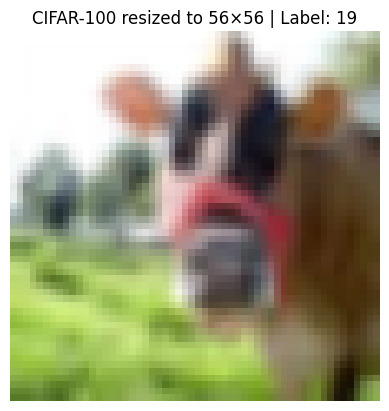
patch = img[:, 49:56, 49:56]  # [3, 7, 7]
print("Patch shape:", patch.shape)
print("Pixel value range:", patch.min().item(), "to", patch.max().item())
Patch shape: torch.Size([3, 7, 7])
Pixel value range: 0.007843137718737125 to 0.6784313917160034patch_flat = patch.reshape(-1) # [147]
print("Flattened patch (decoder target):", patch_flat.shape)
# so the decoder must predict these 147 valuesFlattened patch (decoder target): torch.Size([147])patch_flattensor([0.3569, 0.2863, 0.2196, 0.2510, 0.2863, 0.3098, 0.3255, 0.2980, 0.2235,
0.1725, 0.2196, 0.2706, 0.2941, 0.3098, 0.2314, 0.1569, 0.1255, 0.1922,
0.2588, 0.2824, 0.2980, 0.1961, 0.1294, 0.1059, 0.2118, 0.3255, 0.3882,
0.4275, 0.1647, 0.1059, 0.0941, 0.2392, 0.3922, 0.4902, 0.5529, 0.1373,
0.0980, 0.1137, 0.2588, 0.4078, 0.4941, 0.5451, 0.1216, 0.0941, 0.1294,
0.2745, 0.4196, 0.4941, 0.5412, 0.2980, 0.2235, 0.1608, 0.1961, 0.2431,
0.2824, 0.3020, 0.2471, 0.1686, 0.1176, 0.1725, 0.2431, 0.2784, 0.2980,
0.1922, 0.1137, 0.0745, 0.1569, 0.2471, 0.2824, 0.3020, 0.1608, 0.0902,
0.0667, 0.2039, 0.3490, 0.4235, 0.4667, 0.1333, 0.0745, 0.0667, 0.2549,
0.4549, 0.5647, 0.6353, 0.1098, 0.0745, 0.1098, 0.3020, 0.5020, 0.6000,
0.6627, 0.0941, 0.0745, 0.1333, 0.3333, 0.5333, 0.6235, 0.6784, 0.1804,
0.1137, 0.0549, 0.0627, 0.0824, 0.1059, 0.1176, 0.1216, 0.0627, 0.0275,
0.0431, 0.0667, 0.0824, 0.0941, 0.0627, 0.0157, 0.0078, 0.0314, 0.0588,
0.0706, 0.0784, 0.0431, 0.0118, 0.0078, 0.0745, 0.1451, 0.1843, 0.2118,
0.0275, 0.0078, 0.0118, 0.1176, 0.2275, 0.2980, 0.3373, 0.0314, 0.0196,
0.0275, 0.1294, 0.2314, 0.2863, 0.3216, 0.0314, 0.0235, 0.0392, 0.1373,
0.2353, 0.2824, 0.3098])random_prediction = torch.rand(147) # untrained decoder output
trained_prediction = patch_flat + torch.randn(147) * 0.05 # nearly trained decoder simulation, just the patch with noisefig, axes = plt.subplots(1, 3, figsize=(10, 3))
axes[0].imshow(patch.permute(1, 2, 0)) # [H, W, C]
axes[0].set_title("Ground truth patch\n(decoder target)")
axes[1].imshow(random_prediction.reshape(3, 7, 7).permute(1, 2, 0).clamp(0, 1))
axes[1].set_title("Random prediction\n(untrained decoder)")
axes[2].imshow(trained_prediction.reshape(3, 7, 7).permute(1, 2, 0).clamp(0, 1))
axes[2].set_title("Good prediction\n(trained decoder)")
for ax in axes:
ax.axis('off')
plt.suptitle(f"Single 7×7 patch = {147} pixel values the decoder must predict")
plt.tight_layout()
print(f"Loss (random): {F.mse_loss(random_prediction, patch_flat):.4f}")
print(f"Loss (trained): {F.mse_loss(trained_prediction, patch_flat):.4f}")
plt.show()Loss (random): 0.1964
Loss (trained): 0.0024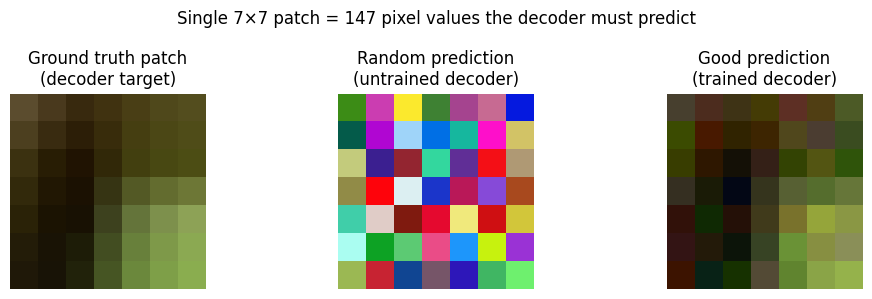
Ok, lets build it out
from vit import TransformerBlockimport numpy as np
class PredictPixel(nn.Module):
def __init__(self, decoder_hidden_dim, patch_size, mask_ratio = .75):
super().__init__()
self.decoder_hidden_dim = decoder_hidden_dim
self.patch_size = patch_size
self.ll = nn.Linear(decoder_hidden_dim, patch_size * patch_size * 3)
def forward(self, x):
"""
Decoder gives us one vetor per patch position.
Each patch is 7x7x3. So each patch has 147 pixel values.
"""
x = self.ll(x)
return x
class Mask(nn.Module):
def __init__(self, mask_ratio = .75):
super().__init__()
self.mask_ratio = mask_ratio
def forward(self, x):
num_patches = x.shape[1]
perm = torch.randperm(num_patches)
masked_locations = perm[:int(num_patches * 0.75)]
un_masked_locations = perm[int(num_patches * 0.75):]
masked_patches = x[:, masked_locations, :] # shape: [2, 48, 256]
un_masked_patches = x[:, un_masked_locations, :] # shape: [2, 48, 256]
return un_masked_patches, masked_patches, masked_locations, un_masked_locations
class Decoder(nn.Module):
"""
Take the encoded patches that have not been masked and re-construct
"""
def __init__(self, decoder_hidden_dim, hidden_dim, num_heads, depth, num_patches):
super().__init__()
self.decoder_hidden_dim = decoder_hidden_dim
self.hidden_dim = hidden_dim
self.num_heads = num_heads
self.num_patches = num_patches
self.project_down = nn.Linear(hidden_dim,decoder_hidden_dim )
self.pos_embedding = nn.Parameter(torch.randn(1, self.num_patches , decoder_hidden_dim))
self.mask_token = nn.Parameter(torch.randn(1, 1, decoder_hidden_dim))
self.transformer_block = TransformerBlock(decoder_hidden_dim, num_heads, mlp_dim = decoder_hidden_dim*4)
self.layers = nn.ModuleList(
[TransformerBlock(decoder_hidden_dim, num_heads, mlp_dim = decoder_hidden_dim*4) for _ in range(depth)
])
def forward(self, x, masked_locations, un_masked_locations):
B, num_masked, _ = x.shape
x = self.project_down(x)
# now we need to create the full 64 patch tensors to feed that through the linear layer for pixel predictions
mask_tokens = self.mask_token.expand(B, len(masked_locations), self.decoder_hidden_dim)
full_sequence = torch.zeros(B, 64, self.decoder_hidden_dim, device = x.device)
full_sequence[:, un_masked_locations, :] = x # projected encoder output
full_sequence[:, masked_locations, :] = mask_tokens
full_sequence = full_sequence + self.pos_embedding
for block in self.layers:
full_sequence = block(full_sequence)
return full_sequenceOne thing I didnt know the differnce between
nn.Sequentialandnn.ModuleListnn.ModuleList is just a container — it stores modules but doesn’t have a forward method. You can’t call self.layers(x).
You can use nn.Sequential for the encode/decoder, but ModuleList gives you more control (you can skip layers, add conditions, etc.), which is why most transformer implementations use it with a loop.
class MAE(nn.Module):
      def __init__(self, img_size, patch_size, num_hiddens, num_heads,mask_ratio,decoder_hidden_dim, depth=6, dropout=0.1):
          super().__init__()
          self.num_patches = (img_size // patch_size) ** 2
          self.mask_ratio = mask_ratio
          self.depth = depth
          self.patch_size = patch_size

          # --- Patch Embedding ---
          self.patch_embedding = PatchEmbedding(img_size, patch_size, num_hiddens)

          # -- maksing ###
          self.mask = Mask()
          # --- Positional Embedding (+1 for CLS) ---
          self.pos_embedding = nn.Parameter(torch.randn(1, self.num_patches, num_hiddens))

          # --- Transformer Encoder ---
          self.encoder = TransformerEncoder(num_hiddens, depth, num_heads,  mlp_dim=num_hiddens*4)
          # --- Decoder ---
          self.decoder = Decoder(decoder_hidden_dim, num_hiddens, num_heads, depth, num_patches = self.num_patches)
          # picel predict
          self.pixel_head = PredictPixel(decoder_hidden_dim, self.patch_size)

      def forward(self, x):
        # 1. Patch embed: [B, 3, H, W] -> [B, num_patches, num_hiddens]
        B = x.shape[0]
        # save the raw patches as targets before we add embeddings
        raw = x.unfold(2, self.patch_size, self.patch_size).unfold(3, self.patch_size, self.patch_size)
        raw = raw.permute(0, 2, 3, 1, 4, 5).reshape(B, -1, self.patch_size * self.patch_size * 3)
        patches = self.patch_embedding(x)
        patches = patches.flatten(2).transpose(1, 2)
        ## Mask 75% of input patches
        patches = patches + self.pos_embedding
        un_masked_patches, masked_patches, masked_locations, un_masked_locations = self.mask(patches)
        total_num_patches = len(masked_locations) + len(un_masked_locations)
        #   # 4. Transformer encoder
        x = self.encoder(un_masked_patches)
        #   decoder
        x = self.decoder(x,  masked_locations, un_masked_locations)
        x = self.pixel_head(x)
        predictions = x[:, masked_locations, :]  # pixel predictions of masked patches
        targets = raw[:, masked_locations, :]
        loss = F.mse_loss(predictions, targets)
        return loss, x
img = torch.randn(2, 3, 56, 56)mae_model = MAE(patch_size =7, num_hiddens=256, num_heads=8,mask_ratio=.75, decoder_hidden_dim = 128, img_size = 56)loss, out = mae_model(img)losstensor(2.0262, grad_fn=<MseLossBackward0>)def visualize_mae(model, dataset, device, patch_size=7, img_size=56):
model.to(device)
model.eval()
img, label = dataset[0]
x = img.unsqueeze(0).to(device) # [1, 3, 56, 56]
with torch.no_grad():
# Get patches and mask
patches = model.patch_embedding(x)
patches = patches.flatten(2).transpose(1, 2)
patches = patches + model.pos_embedding
un_masked_patches, masked_patches, masked_locations, un_masked_locations = model.mask(patches)
# Encode and decode
encoded = model.encoder(un_masked_patches)
decoded = model.decoder(encoded, masked_locations, un_masked_locations)
predicted = model.pixel_head(decoded) # [1, 64, 147]
# Build raw patches as target
grid_size = img_size // patch_size
raw_patches = img.unfold(1, patch_size, patch_size).unfold(2, patch_size, patch_size)
# [3, 8, 8, 7, 7] -> [64, 3, 7, 7]
raw_patches = raw_patches.permute(1, 2, 0, 3, 4).reshape(-1, 3, patch_size, patch_size)
# Reconstruct images
pred_patches = predicted[0].cpu().reshape(-1, 3, patch_size, patch_size).clamp(0, 1)
fig, axes = plt.subplots(1, 4, figsize=(20, 5))
# 1. Original image
axes[0].imshow(img.permute(1, 2, 0))
axes[0].set_title("Original")
# 2. Masked image (only visible patches shown)
masked_img = torch.zeros_like(img)
for idx in un_masked_locations:
row = idx // grid_size
col = idx % grid_size
masked_img[:, row*patch_size:(row+1)*patch_size, col*patch_size:(col+1)*patch_size] = \
img[:, row*patch_size:(row+1)*patch_size, col*patch_size:(col+1)*patch_size]
axes[1].imshow(masked_img.permute(1, 2, 0))
axes[1].set_title(f"Visible patches ({len(un_masked_locations)}/64)")
# 3. Reconstruction (full)
recon_img = torch.zeros(3, img_size, img_size)
for i in range(grid_size * grid_size):
row = i // grid_size
col = i % grid_size
recon_img[:, row*patch_size:(row+1)*patch_size, col*patch_size:(col+1)*patch_size] = \
pred_patches[i]
axes[2].imshow(recon_img.permute(1, 2, 0).clamp(0, 1))
axes[2].set_title("Full reconstruction")
# 4. Only masked patches reconstructed, visible patches from original
mixed_img = img.clone()
for idx in masked_locations:
row = idx // grid_size
col = idx % grid_size
mixed_img[:, row*patch_size:(row+1)*patch_size, col*patch_size:(col+1)*patch_size] = \
pred_patches[idx]
axes[3].imshow(mixed_img.permute(1, 2, 0).clamp(0, 1))
axes[3].set_title("Masked patches filled in")
for ax in axes:
ax.axis('off')
plt.tight_layout()
plt.show()device = torch.device('cuda' if torch.cuda.is_available() else 'mps' if torch.backends.mps.is_available() else 'cpu')
print(f"Using: {device}")Using: mpsvisualize_mae(mae_model, train_dataset_raw, device)# untrained model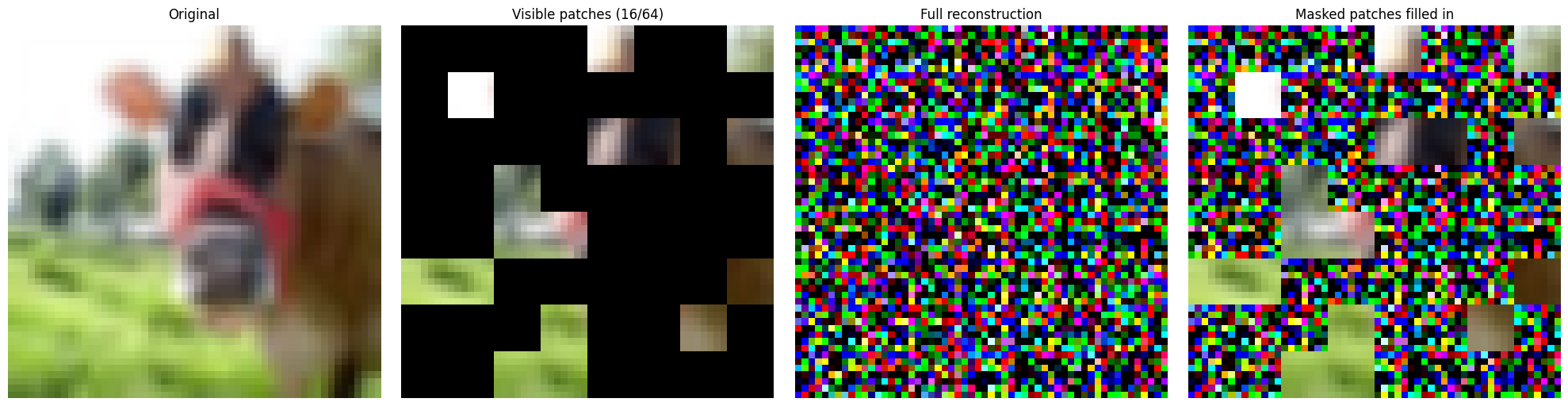
training loop
from torch.utils.data import DataLoader
transform = transforms.Compose([
      transforms.Resize((56, 56)),
      transforms.ToTensor(),
  ])

train_dataset = CIFAR100(root='./data', train=True, download=True, transform=transform)
train_loader = DataLoader(train_dataset, batch_size=32, shuffle=True)

model = MAE(
    img_size=56, patch_size=7, num_hiddens=256, num_heads=8,
    mask_ratio=0.75, decoder_hidden_dim=128, depth=2, dropout=0.1
).to(device)

optimizer = torch.optim.Adam(model.parameters(), lr=3e-4)
for epoch in range(50):
model.train()
total_loss = 0
for images, _ in train_loader:
images = images.to(device)
loss, predictions = model(images)
optimizer.zero_grad()
loss.backward()
optimizer.step()
total_loss += loss.item()
print(f"Epoch {epoch+1} | Loss: {total_loss/len(train_loader):.4f}")modelMAE(
(patch_embedding): PatchEmbedding(
(conv): Conv2d(3, 256, kernel_size=(7, 7), stride=(7, 7))
)
(mask): Mask()
(encoder): TransformerEncoder(
(layers): ModuleList(
(0-1): 2 x TransformerBlock(
(norm1): LayerNorm((256,), eps=1e-05, elementwise_affine=True)
(attn): MultiHeadAttention(
(heads): ModuleList(
(0-7): 8 x AttentionHead(
(q): Linear(in_features=256, out_features=32, bias=False)
(k): Linear(in_features=256, out_features=32, bias=False)
(v): Linear(in_features=256, out_features=32, bias=False)
(dropout): Dropout(p=0.1, inplace=False)
)
)
(proj): Linear(in_features=256, out_features=256, bias=True)
(dropout): Dropout(p=0.1, inplace=False)
)
(norm2): LayerNorm((256,), eps=1e-05, elementwise_affine=True)
(ffn): FeedForward(
(net): Sequential(
(0): Linear(in_features=256, out_features=1024, bias=True)
(1): GELU(approximate='none')
(2): Dropout(p=0.1, inplace=False)
(3): Linear(in_features=1024, out_features=256, bias=True)
(4): Dropout(p=0.1, inplace=False)
)
)
)
)
(norm): LayerNorm((256,), eps=1e-05, elementwise_affine=True)
)
(decoder): Decoder(
(project_down): Linear(in_features=256, out_features=128, bias=True)
(transformer_block): TransformerBlock(
(norm1): LayerNorm((128,), eps=1e-05, elementwise_affine=True)
(attn): MultiHeadAttention(
(heads): ModuleList(
(0-7): 8 x AttentionHead(
(q): Linear(in_features=128, out_features=16, bias=False)
(k): Linear(in_features=128, out_features=16, bias=False)
(v): Linear(in_features=128, out_features=16, bias=False)
(dropout): Dropout(p=0.1, inplace=False)
)
)
(proj): Linear(in_features=128, out_features=128, bias=True)
(dropout): Dropout(p=0.1, inplace=False)
)
(norm2): LayerNorm((128,), eps=1e-05, elementwise_affine=True)
(ffn): FeedForward(
(net): Sequential(
(0): Linear(in_features=128, out_features=512, bias=True)
(1): GELU(approximate='none')
(2): Dropout(p=0.1, inplace=False)
(3): Linear(in_features=512, out_features=128, bias=True)
(4): Dropout(p=0.1, inplace=False)
)
)
)
(layers): ModuleList(
(0-1): 2 x TransformerBlock(
(norm1): LayerNorm((128,), eps=1e-05, elementwise_affine=True)
(attn): MultiHeadAttention(
(heads): ModuleList(
(0-7): 8 x AttentionHead(
(q): Linear(in_features=128, out_features=16, bias=False)
(k): Linear(in_features=128, out_features=16, bias=False)
(v): Linear(in_features=128, out_features=16, bias=False)
(dropout): Dropout(p=0.1, inplace=False)
)
)
(proj): Linear(in_features=128, out_features=128, bias=True)
(dropout): Dropout(p=0.1, inplace=False)
)
(norm2): LayerNorm((128,), eps=1e-05, elementwise_affine=True)
(ffn): FeedForward(
(net): Sequential(
(0): Linear(in_features=128, out_features=512, bias=True)
(1): GELU(approximate='none')
(2): Dropout(p=0.1, inplace=False)
(3): Linear(in_features=512, out_features=128, bias=True)
(4): Dropout(p=0.1, inplace=False)
)
)
)
)
)
(pixel_head): PredictPixel(
(ll): Linear(in_features=128, out_features=147, bias=True)
)
)Now we can compare the trained model
- this was only trained for 30 epochs, but its much closer to reality than random!
visualize_mae(model, train_dataset_raw, device)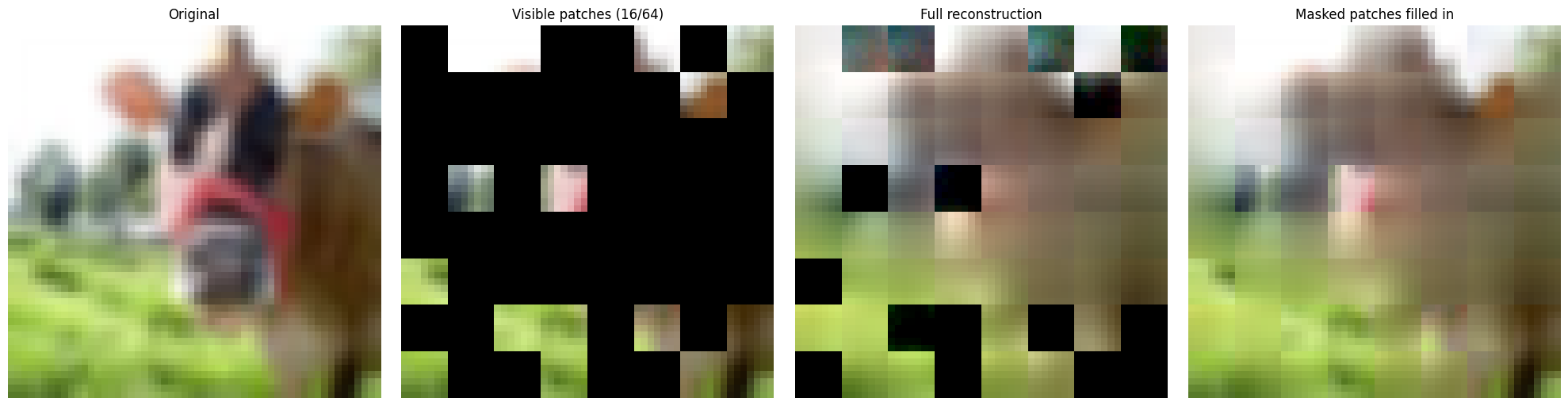
Now lets explore a transformers implementation from HuggingFace
# !pip install transformers
from transformers import ViTMAEModel, ViTMAEForPreTraining

model = ViTMAEForPreTraining.from_pretrained("facebook/vit-mae-base")
print(model)
/Users/jpoberhauser/mambaforge3/envs/sam2_env/lib/python3.11/site-packages/tqdm/auto.py:21: TqdmWarning: IProgress not found. Please update jupyter and ipywidgets. See https://ipywidgets.readthedocs.io/en/stable/user_install.html
from .autonotebook import tqdm as notebook_tqdm
Loading weights: 100%|██████████| 334/334 [00:00<00:00, 8620.75it/s]ViTMAEForPreTraining(
(vit): ViTMAEModel(
(embeddings): ViTMAEEmbeddings(
(patch_embeddings): ViTMAEPatchEmbeddings(
(projection): Conv2d(3, 768, kernel_size=(16, 16), stride=(16, 16))
)
)
(encoder): ViTMAEEncoder(
(layer): ModuleList(
(0-11): 12 x ViTMAELayer(
(attention): ViTMAEAttention(
(attention): ViTMAESelfAttention(
(query): Linear(in_features=768, out_features=768, bias=True)
(key): Linear(in_features=768, out_features=768, bias=True)
(value): Linear(in_features=768, out_features=768, bias=True)
)
(output): ViTMAESelfOutput(
(dense): Linear(in_features=768, out_features=768, bias=True)
(dropout): Dropout(p=0.0, inplace=False)
)
)
(intermediate): ViTMAEIntermediate(
(dense): Linear(in_features=768, out_features=3072, bias=True)
(intermediate_act_fn): GELUActivation()
)
(output): ViTMAEOutput(
(dense): Linear(in_features=3072, out_features=768, bias=True)
(dropout): Dropout(p=0.0, inplace=False)
)
(layernorm_before): LayerNorm((768,), eps=1e-12, elementwise_affine=True)
(layernorm_after): LayerNorm((768,), eps=1e-12, elementwise_affine=True)
)
)
)
(layernorm): LayerNorm((768,), eps=1e-12, elementwise_affine=True)
)
(decoder): ViTMAEDecoder(
(decoder_embed): Linear(in_features=768, out_features=512, bias=True)
(decoder_layers): ModuleList(
(0-7): 8 x ViTMAELayer(
(attention): ViTMAEAttention(
(attention): ViTMAESelfAttention(
(query): Linear(in_features=512, out_features=512, bias=True)
(key): Linear(in_features=512, out_features=512, bias=True)
(value): Linear(in_features=512, out_features=512, bias=True)
)
(output): ViTMAESelfOutput(
(dense): Linear(in_features=512, out_features=512, bias=True)
(dropout): Dropout(p=0.0, inplace=False)
)
)
(intermediate): ViTMAEIntermediate(
(dense): Linear(in_features=512, out_features=2048, bias=True)
(intermediate_act_fn): GELUActivation()
)
(output): ViTMAEOutput(
(dense): Linear(in_features=2048, out_features=512, bias=True)
(dropout): Dropout(p=0.0, inplace=False)
)
(layernorm_before): LayerNorm((512,), eps=1e-12, elementwise_affine=True)
(layernorm_after): LayerNorm((512,), eps=1e-12, elementwise_affine=True)
)
)
(decoder_norm): LayerNorm((512,), eps=1e-12, elementwise_affine=True)
(decoder_pred): Linear(in_features=512, out_features=768, bias=True)
)
)